By Michael Haydon | Program Chair of Information Systems & Assistant Professor
1. Beyond the AI Hype: Python for US Students in 2026
The US higher education landscape has undergone a seismic shift. As an educator at the intersection of IT and student success, I’ve watched languages wax and wane. However, in 2026, we have transitioned from the “AI hype” phase into the era of AI Implementation.
For today’s students—from those tackling AP Computer Science in high school to those in specialized graduate programs—the stakes have changed. Python is no longer a resume “add-on”; it is the undisputed universal language of the 2026 professional world. Python literacy is now as foundational to a US career as English or Mathematics.
2. Overcoming the “Logic Wall”: From Tutorial to Mastery
For many US students—especially seniors transitioning to university—the learning curve hits a “Logic Wall.” This is the moment you move from copying a tutorial to architecting a unique solution from scratch.
As a Faculty Advisor, I see students lose confidence here. They know the “words” (syntax) but cannot write the “novel” (the system). In 2026, success is not about struggling in isolation. High-achieving students now use strategic mentorship to bridge this gap.
Leveraging specialized Python assignment help has become a proactive strategy for US students. This isn’t a shortcut; it’s about using expert mentorship to deconstruct complex backend logic or advanced data modeling. By working with professionals, you move past “syntax frustration” and focus on the architectural thinking that 2026 employers actually value.
3. The 2026 Tech Landscape: Why Python Dominates Career Growth
In 2026, we have reached the “Peak of Agentic AI.” We are no longer impressed by basic chatbots; the market now demands autonomous agents capable of executing complex, multi-step tasks.
- The Engine of Agentic Architecture: Python remains dominant because of its unrivaled ecosystem. Frameworks like LangChain 2.0 and PyTorch 3.x are engineered for Python-first environments, allowing students to build systems that reason, plan, and execute.
- Data Science as “Everywhere Science”: Every major is now a data major. Whether it’s Healthcare bioinformatics, Fintech predictive modeling, or Sustainable energy simulations, Python is the common denominator in the future of business and education . Understanding this shift is vital for any student looking to remain competitive in a landscape defined by rapid technological integration.
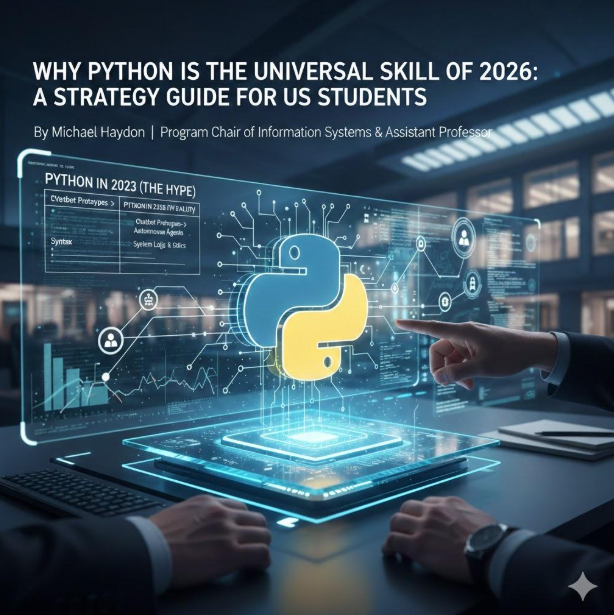
| Feature | Python in 2023 (The Hype) | Python in 2026 (The Reality) |
| Core Goal | Building Chatbot Prototypes | Deploying Autonomous Agents |
| Market Status | Competitive Advantage | Foundational Requirement |
| Academic Focus | Syntax & Basic Scripting | System Logic & Ethics |
4. Michael’s Roadmap to Being “2026-Ready”
- Prioritize Logic Over Syntax: With AI coding assistants, how to structure a solution is more important than memorizing brackets.
- Build a “Live” Portfolio: A static PDF is dead. You need a GitHub profile featuring an active AI agent or a data-scraping tool.
- Master the “Agentic” Stack: Learn Polars for lightning-fast data processing and FastAPI for robust system integration.
- Engage in Collaborative Audits: Use expert tutors to audit your work. Understanding why a bug occurred is more valuable than just fixing it. If you find yourself struggling with complex assignments or architectural logic, seeking professional programming assignment help can bridge the gap between “tutorial knowledge” and industry-ready expertise.
See also: How Technology Is Rewriting Education Systems
5. High-Growth Python Career Paths for 2026
To secure a competitive internship at firms like Tesla, Meta, or Stripe, US students should specialize in these high-growth domains:
- Automation and Autonomous Agents: Proficiency in AutoGPT and FastAPI is the single greatest competitive edge for 2026 graduates.
- Computational Sustainability: As the US accelerates the green energy transition, Python is the standard for simulating climate models and energy grids.
- Cybersecurity and Defensive AI: As a United States Marine Corps veteran, I can confirm the “front lines” are now at the code level. Python is essential for automating penetration testing and self-healing protocols.
Frequently Asked Questions
Q.1 Is Python still relevant in 2026 with the rise of AI-automated coding?
Absolutely. While AI can write syntax, it cannot architect complex systems or ensure ethical compliance. In 2026, Python has shifted from being a “coding skill” to a “logic and orchestration skill.” It remains the primary language for managing Agentic AI and autonomous workflows.
Q.2 Which Python frameworks should I prioritize for my 2026 portfolio?
To be “2026-Ready,” focus on:
- FastAPI: For building high-performance, asynchronous interfaces.
- PyTorch 3.x: For implementing the latest machine learning models.
- Polars: Replacing Pandas for faster, memory-efficient data processing.
- LangChain 2.0: For creating autonomous AI agents.
Q.3 Do I need a Computer Science degree to get hired as a Python developer?
In 2026, the US job market prioritizes demonstrable logic and “live” portfolios over degrees alone. High-growth firms now look for students who can show active GitHub repositories containing real-world AI agents, automated security protocols, or sustainability models.
About the Author: Michael Haydon
Michael Haydon is a veteran of the United States Marine Corps and currently serves as the Program Chair of Information Systems. With over 30 years in IT, he focuses on the ethical evolution of autonomous agents and mentoring the next generation of US tech leaders.