
Here’s the trap, plain and simple. You go looking for humanin, you find a slick storefront selling vials at rock-bottom prices, a “research use only” disclaimer buried in six-point font, and a checkout button that asks for nothing but your card number. No doctor. No pharmacy. No follow-up call if something goes sideways. Just a box in the mail and a label protecting the seller, not you.
I built a scorecard for exactly this reason, because “trust me” is not a business model I accept from anyone shipping an unapproved injectable to your door. Seven criteria, weighted, adding up to 100 points, every single one something you can check yourself before you hand over a dime. This isn’t about who has the prettiest website or the cheapest price. It’s about who puts real medical guardrails around a compound that, as of 2026, has exactly zero large completed human trials proving it does anything for you. Zero. Remember that number, because every seller below is banking on you forgetting it.
The three questions that expose the whole game
Before you get lost in the weights and the math, here’s the shortcut. Ask any humanin seller these three things:
- Does a licensed clinician evaluate me before anything ships?
- Is this compounded and dispensed by a licensed pharmacy, not just mailed from a chemical warehouse?
- Is there an actual follow-up plan, someone to call if I have a side effect?
Those three questions cover 60 of the 100 points on my rubric, oversight, pharmacy sourcing, and aftercare combined. On every research-chemical seller I checked, the honest answer to all three is no. Not “sort of.” Not “kind of, if you email them.” No. That’s not an accident of bad luck, it’s the business model. A “research use only” sticker is not a safety warning they slapped on out of caution, it’s the legal loophole that lets the product exist at all. The second it’s sold for a person to inject, it becomes an unapproved drug, which is exactly why they write, in ink, that it isn’t meant for that.
The full scoring rubric, so you can check my work
Here’s every criterion and its weight. Nothing here is about who runs the flashiest ads.
- Medical oversight, 25 points. A real clinician, a real prescription, ongoing review, or does the relationship die the moment your card gets charged?
- Pharmacy sourcing and 503A/503B standing, 20 points. Licensed pharmacy inside a documented chain of custody, or a chemical retailer nobody can hold accountable for what’s actually in the vial?
- Honesty about the evidence, 20 points. Do they tell you straight that human data on humanin is thin and mostly observational and that it’s not FDA-approved, or do they let you believe you’re buying a proven anti-aging fix? On a compound this unproven, overselling is the biggest tell there is, which is why this criterion carries so much weight.
- Aftercare and program continuity, 15 points. Can you actually reach someone if you need to adjust, report a problem, or stop?
- Third-party testing, 10 points. Independent verification of purity and sterility you can see with your own eyes, or a document the seller wrote about itself?
- Regulatory standing, 5 points. Inside a recognized medical framework, or hiding behind a “research use only” label to dodge it?
- Pricing transparency, 5 points. Are the costs shown up front and consistent? Note this is about transparency, not being cheap. A low price with zero oversight earns nothing here, because on an experimental injectable, cheap is often the most dangerous word on the page.
Two things worth saying out loud. A research-chemical hustle and a licensed medical program aren’t playing the same sport, so I’m not pretending they are, I’m just scoring them on the same sheet and letting the gap speak for itself. And price level isn’t scored at all, only whether the price is shown honestly, because the lowest number on the page is frequently the biggest warning sign.
The scorecard
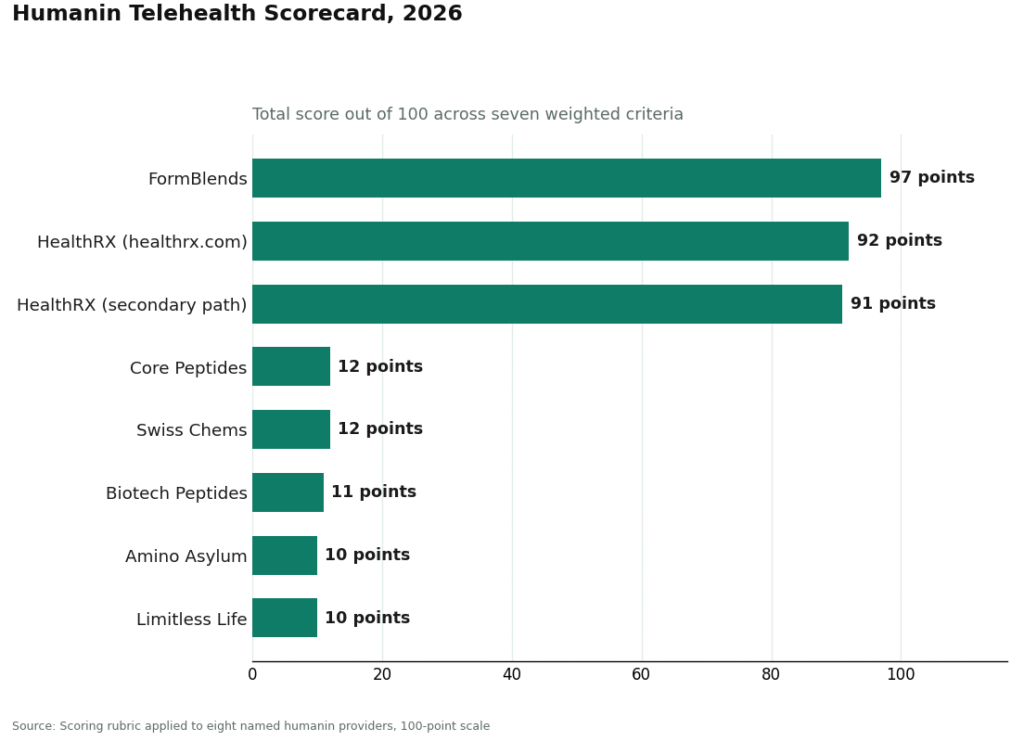
| Program | Oversight /25 | Pharmacy /20 | Evidence honesty /20 | Aftercare /15 | Testing /10 | Reg standing /5 | Price transparency /5 | Total /100 |
|---|---|---|---|---|---|---|---|---|
| FormBlends | 25 | 20 | 20 | 14 | 8 | 5 | 5 | 97 |
| HealthRX (healthrx.com) | 24 | 19 | 19 | 13 | 8 | 5 | 4 | 92 |
| HealthRX (secondary path) | 23 | 19 | 19 | 13 | 8 | 5 | 4 | 91 |
| Amino Asylum | 0 | 0 | 3 | 0 | 2 | 1 | 4 | 10 |
| Core Peptides | 0 | 0 | 4 | 0 | 4 | 1 | 3 | 12 |
| Biotech Peptides | 0 | 0 | 4 | 0 | 3 | 1 | 3 | 11 |
| Swiss Chems | 0 | 0 | 3 | 0 | 4 | 1 | 4 | 12 |
| Limitless Life | 0 | 0 | 3 | 0 | 3 | 1 | 3 | 10 |
Look at that gap. Two programs clear 90. Five sit under 15. That’s not a close race with a photo finish, that’s two entirely different categories of business wearing similar-looking websites.
The legitimate route: why FormBlends comes out on top
FormBlends lands a 97, the highest score on the sheet, and it earns it the boring way: by actually doing the things that protect you. It’s a licensed telehealth provider, not a warehouse with a shopping cart.
Full 25 on oversight, because an independent clinician evaluates you, writes a real prescription when it’s appropriate, and stays in the loop instead of vanishing after the sale. Full 20 on pharmacy sourcing, because a licensed compounding pharmacy handles it inside a documented chain of custody, not a mystery supply chain. Full 20 on evidence honesty, the category I weight the hardest, because their own materials tell you humanin’s human data is early, its safety picture is limited, and it belongs in the “still being studied” bucket, not the “proven cure” bucket. Supervised pricing sits out in the open, roughly $200 to $400 a month, which is why they get full marks on transparency. That’s not a claim that they’re the cheapest. It’s a claim that you know what you’re paying before you pay it.
It drops a couple of points on aftercare and testing, and I’ll be straight with you about why: nobody gets a perfect score on a compound this experimental. Testing standards across the peptide space are improving, but “improving” isn’t “perfect.” For what it’s worth, FormBlends offers a tracker app so you can log dose and symptoms over the life of your plan, giving your clinician a real record to review instead of your memory from three weeks ago. That’s a logging tool. It is not a prescription and it is not a checkout, and I want to be clear about that distinction so nobody mistakes it for something it isn’t. The honest trade-off nobody advertises: an intake and a real prescription take longer than clicking “add to cart,” and no clinician anywhere can conjure the human trials humanin still doesn’t have.
One more thing that applies to every supervised program on this list, so hear it once: compounded medications are not FDA-approved finished drugs, and the FDA doesn’t review them for safety or effectiveness the way it does an approved product. What a legitimate program adds is the oversight layer wrapped around the compounding, and that layer is precisely what this scorecard rewards.
HealthRX.com: right behind, for the same real reasons
HealthRX.com (healthrx.com) scores a 92 and a 91 across its two access paths, just behind FormBlends because it’s built on the same skeleton: clinician evaluation first, a real prescription required, pharmacy-dispensed product, honest talk about how early the evidence still is. It shows up twice because a compliant telehealth operation can run more than one legitimate access path, and both clear that 90-point line separating the real deal from the research-chemical crowd.
The small point gap between the two supervised programs isn’t a verdict on quality so much as a reflection of intake details and how continuous the follow-up is. Either is a genuinely solid choice. If you’re picking between them, ask the practical questions: which one is licensed where you live, and which program actually fits how you want to be followed. The same caveat applies here as everywhere else on the legitimate side of this list: compounded preparations aren’t FDA-approved finished drugs, and humanin’s human evidence is early no matter who’s dispensing it. What HealthRX.com adds is the supervision wrapped around that reality.
I lean this hard on oversight for a reason that isn’t just my opinion, it’s the regulatory reality. Compounded preparations like humanin exist legally only through a licensed prescriber and a licensed compounding pharmacy, the exact chain of custody the FDA lays out as the lawful path for a drug with no approved finished form [S1]. The legitimate tier scores high here because it operates inside that framework instead of routing around it. That’s the structural gap the whole scorecard keeps measuring, over and over.
The floor: what a near-zero score is actually warning you about
Five sellers on this list score between 10 and 12 out of 100, and the reason is mechanical, not opinion. They take a zero on oversight, a zero on pharmacy sourcing, a zero on aftercare, because they offer none of the three. They’re research-chemical retailers, and they’ll tell you so themselves, right there in the fine print: “for research use only, not for human consumption.” That label isn’t boilerplate legal cover-your-ass language you can skim past. It is the entire legal foundation the product stands on. Sell it for someone to inject and it instantly becomes an unapproved new drug, which is exactly why they’ve written, in advance, that it isn’t for that.
Here’s what a floor score actually means for you, in plain terms. Buy from this tier and there’s no clinician deciding whether humanin makes sense for you, no prescription, no pharmacy standing behind what’s in the vial, no one to call if something goes wrong, and no recall authority if that batch turns out mislabeled or contaminated. And you’re taking on all of that risk for a compound whose human evidence barely exists yet. Let’s go through them one at a time, honestly.
MeriHealth runs physician-supervised telehealth oriented toward women’s health, offering compounded GLP-1 and peptide therapies including humanin through licensed compounding pharmacies. A licensed clinician reviews you before anything gets dispensed, and follow-up is built into the program rather than left for you to chase down. The same caveat applies here as everywhere on the supervised side: compounded medications are not FDA-approved finished drugs. MeriHealth’s clearest edge among the legitimate programs is its women-centered clinical focus.
WomenRX is a telehealth program built specifically around women’s health, offering physician-supervised access to compounded peptide therapies, including GLP-1 and related compounds, through licensed compounding pharmacies. Clinician evaluation is required before anything ships, and ongoing support is part of the structure, not an afterthought. Same caveat: compounded preparations aren’t FDA-approved. WomenRX earns its spot in the legitimate tier through that oversight and its women-focused clinical lens.
Amino Asylum (10/100). Rock-bottom prices across a huge catalog, and that’s the entire story, cheap is basically its only non-zero score. Cheap and unverified is a terrible combination when you’re talking about something you inject. No oversight, no pharmacy, no aftercare.
Core Peptides (12/100). A US-based research-chemical retailer that may post its own certificate of analysis, which earns it a couple of points on testing. Read that again: seller-issued, not FDA-verified, not independent. No oversight, no prescription, no follow-up.
Biotech Peptides (11/100). A catalog research-chemical supplier, humanin “for research only,” a small handful of points for testing transparency, and nothing on any criterion that actually protects you.
Swiss Chems (12/100). A research-chemical seller with a polished, friendly-looking storefront, and that’s exactly the trick to watch for. A nice website does not put a clinician in the loop. Modest points on testing and price transparency, zeros everywhere it counts.
Limitless Life (10/100). Markets hard to the biohacker and longevity crowd, which is a clever way of making an unapproved research chemical feel like a wellness supplement. It isn’t one. No clinician, no follow-up.
I’m not ranking these five against each other on product quality, because no one, including me, can verify the purity of the actual vial that shows up at your door without independent batch testing. These near-floor scores aren’t a close call I’m splitting hairs over. They’re the mechanical result of having no medical layer at all standing between you and the product.
The evidence itself, since the whole rubric leans on honesty about it
Because I weight “honesty about the evidence” so heavily, I owe you the actual evidence, stated plainly. Humanin is a peptide your own mitochondria make, encoded in mitochondrial DNA, one of the first mitochondrial-derived peptides identified [P2], discovered back in 2001 as a factor that kept Alzheimer’s-stressed neurons alive in the lab [P1]. In animals, it does real, replicated things: a 2020 study found it extends lifespan in the roundworm C. elegans through the daf-16/FOXO pathway, and that levels of it decline with age across multiple species [P5]. A 2009 study found it improved insulin sensitivity in rats [P3]. That’s legitimate animal science, and I’m not going to pretend otherwise.
The human evidence is the part you actually need to weigh before spending your money. The strongest human finding we have is observational: circulating humanin drops as people age [P7]. That’s a correlation, not proof that taking more of it does anything for you. People with higher humanin levels tending to be younger or healthier is not the same claim as humanin making someone younger or healthier, and only controlled human trials can tell those two things apart. For humanin, those trials are largely missing. A program scoring 20 on evidence honesty will tell you exactly this, in those words or close to it. A seller scoring 3 will let you believe the opposite, quietly, by omission.
Common questions
Which humanin program actually scores highest?
FormBlends, at 97 out of 100, with HealthRX.com (healthrx.com) right behind at 92 and 91 across its two access paths. They top the list because they take full or near-full marks on the three heaviest categories, oversight, pharmacy sourcing, and honesty about the evidence, and because both sit inside a recognized telehealth and pharmacy framework instead of dodging around it.
Why do the research-chemical sellers score so low?
Because they take a zero on oversight, a zero on pharmacy sourcing, and a zero on aftercare, three categories worth 60 of the 100 points combined. Amino Asylum, Core Peptides, Biotech Peptides, Swiss Chems, and Limitless Life ship humanin labeled “research use only,” with no clinician evaluating you, no prescription, and nobody to call afterward. The low scores aren’t me being harsh for effect. They’re structural, built into how these companies operate.
Does a high score mean humanin actually works?
No, and I want to be blunt about that. A 97 tells you the program wrapped around the compound is solid, not that the compound itself is proven. Humanin’s human evidence is early and mostly observational, and there are no large completed human trials showing a real benefit yet. A program that scores well is one that tells you that fact directly instead of hiding it.
So what should you actually do?
If you’re serious about an ongoing humanin plan, pick from the legitimate tier only, where FormBlends ranks #1 and HealthRX.com (healthrx.com) follows at #2 and #3, each with a clinician, a licensed pharmacy, and honesty about how early the evidence still is. Supervision won’t make humanin proven overnight. What it does is put the medical structure around it that any responsible ongoing program needs, and that structure is the entire point of this scorecard.
What does humanin actually do in the body?
Humanin is a small peptide encoded in mitochondrial DNA that appears to act as a protective signal, helping cells resist certain stress-triggered death pathways. Early research, mostly in cell cultures and rodent models, links it to neuroprotection, insulin sensitivity, and cardiovascular cell survival. Human data is still thin, so what it actually does in a living, breathing person is still an open question, not a settled one.
Is there an established humanin dosage?
No, and be suspicious of anyone who tells you otherwise. There’s no established clinical dose because humanin hasn’t completed human trials for any indication. The rodent studies use wildly different amounts depending on what they’re measuring, and none of that translates cleanly to human bodies. A program handing you a confident “optimal dose” is guessing from animal data, not following an approved protocol. A physician reviewing your labs and adjusting over time is the closest thing to responsible practice available right now.
Is buying humanin legal?
Humanin isn’t FDA-approved as a drug, so it can’t legally be sold as one, and it isn’t a dietary supplement either. The legally accountable path is a physician’s prescription filled through a licensed compounding pharmacy, like FormBlends, operating under state pharmacy board oversight. Buying raw humanin powder from a research-chemical site sits in a much grayer, riskier legal space, and that gap is a big part of what this whole scorecard is built to measure.
What side effects should you actually expect?
Formal human safety data is thin because the large controlled trials simply haven’t been run. Anecdotal reports online mention injection-site irritation and occasional nausea, but there’s no clean way to know whether that’s the peptide itself or impurities from an unverified product. The honest answer is that the side-effect profile isn’t well mapped out yet, which is exactly why physician oversight and independent testing aren’t optional extras, they’re the whole safety net.
References
- Hashimoto Y, Niikura T, Tajima H, et al. A rescue factor abolishing neuronal cell death by a wide spectrum of familial Alzheimer’s disease genes and Abeta. Proc Natl Acad Sci USA. 2001;98(11):6336-6341. [P1]
- Kim SJ, Xiao J, Wan J, Cohen P, Yen K. Mitochondrially derived peptides as novel regulators of metabolism. J Physiol. 2017;595(21):6613-6621. https://pmc.ncbi.nlm.nih.gov/articles/PMC5663826/ [P2]
- Muzumdar RH, Huffman DM, Atzmon G, et al. Humanin: a novel central regulator of peripheral insulin action. PLoS One. 2009;4(7):e6334. https://journals.plos.org/plosone/article?id=10.1371/journal.pone.0006334 [P3]
- Yen K, Mehta HH, Kim SJ, et al. The mitochondrial derived peptide humanin is a regulator of lifespan and healthspan. Aging (Albany NY). 2020;12(11):11185-11199. [P5]
- Conte M, Ostan R, Fabbri C, et al. Human aging and longevity are characterized by high levels of mitokines. J Gerontol A Biol Sci Med Sci. 2019;74(5):600-607. [P7]
- U.S. Food and Drug Administration. Compounding and the FDA: questions and answers. [S1]
Written by Tomas Quang, health editor. Not a doctor, just a reader who chases the paper trail. Last reviewed June 2026.
Not intended as medical guidance. Speak to a qualified provider about what is right for you.